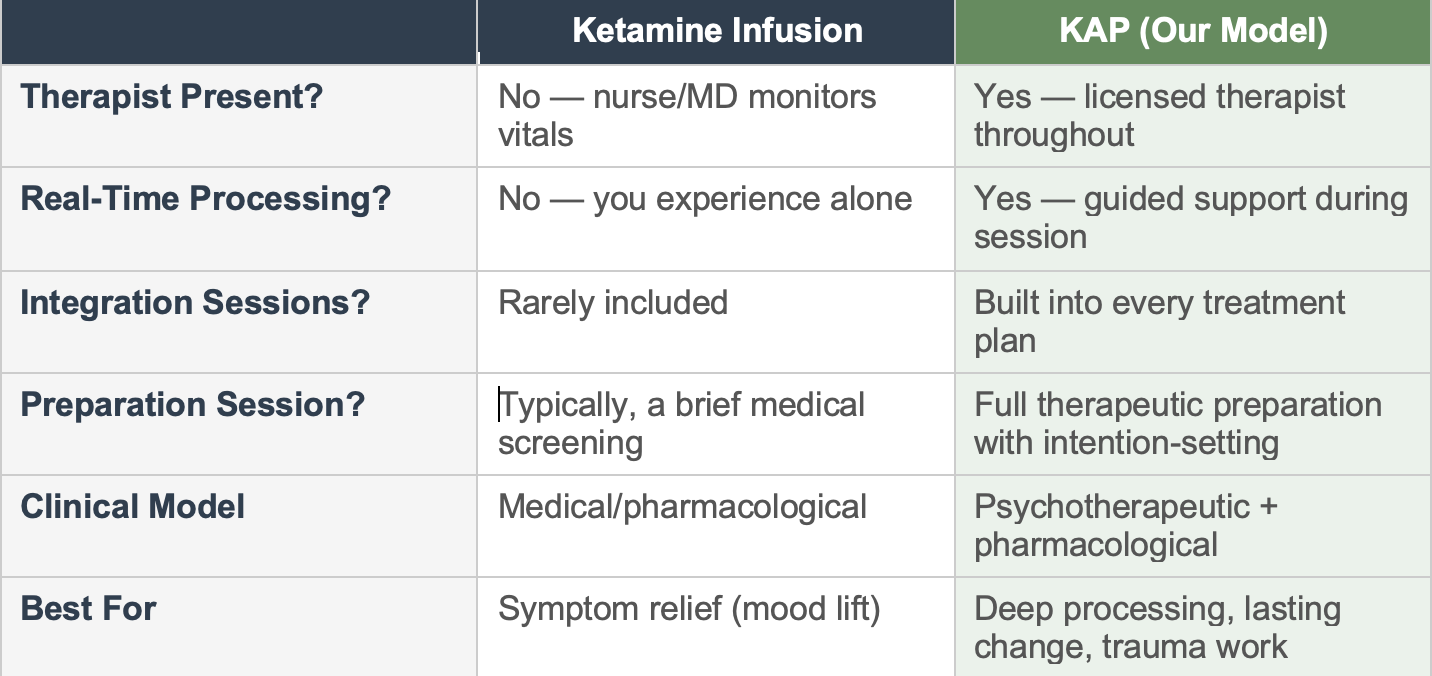
KAP vs. Ketamine Infusion: Why the Therapy Matters
Understanding the difference between ketamine-assisted psychotherapy and ketamine infusion therapy is critical when choosing a provider. Both use the same medication, but the clinical models are fundamentally different:
Ketamine-assisted psychotherapy (KAP) is not just another way to administer ketamine. It’s a fundamentally different clinical model—one that treats ketamine as a tool within a therapeutic relationship, not a standalone medical procedure.
At Lake Austin Psychotherapy, we offer ketamine-assisted psychotherapy in Austin for clients who need more than what traditional therapy or medication has been able to provide. Every session is guided by a licensed therapist who is with you before, during, and after the ketamine experience, helping you make meaning of what surfaces and translating those insights into real, lasting change.
If you’ve been researching ketamine treatment in Austin, you’ve probably noticed that most clinics offer IV infusions in a medical setting—without a therapist in the room. KAP is different, and that difference matters.
Ketamine-Assisted Psychotherapy in Austin, TX
Ketamine infusions can provide temporary symptom relief—and for some people, that’s valuable. But if your goal is to address the underlying causes of your depression, anxiety, or trauma—not just suppress symptoms—then the psychotherapy component is what makes the difference.
How Ketamine-Assisted Psychotherapy Works
The Neuroscience
Ketamine acts primarily on the brain’s glutamate system—the most abundant excitatory neurotransmitter—rather than the serotonin system targeted by conventional antidepressants. This is why ketamine can produce effects in people who haven’t responded to SSRIs or SNRIs.
At sub-anesthetic doses, ketamine promotes neuroplasticity: the brain’s ability to form new neural pathways and weaken old, rigid ones. In clinical terms, this means the entrenched thought patterns, emotional responses, and defensive structures that characterize depression, anxiety, and PTSD become temporarily more flexible. The brain enters a state where it’s more receptive to new perspectives and emotional processing.
The Therapeutic Window
This neuroplastic state is what clinicians call the “therapeutic window.” It’s a period—during and shortly after the ketamine experience—where deeply held beliefs, traumatic memories, and stuck emotional patterns become accessible in a way they normally aren’t.
In an infusion-only model, this window opens and closes without therapeutic support. In KAP, your therapist is present to help you navigate that window—guiding you through what emerges, helping you make connections, and ensuring the experience becomes integrated into your broader healing process.
Why Integration Changes Everything
A ketamine experience without integration is like having a vivid dream you immediately forget. The experience may feel profound in the moment, but without structured follow-up, the insights often fade and the old patterns reassert themselves.
Integration is where the real therapeutic work happens. In dedicated follow-up sessions, your therapist helps you unpack what surfaced during the ketamine experience—connecting it to your history, your relationships, your self-concept, and your treatment goals. This is what transforms a temporary altered state into sustained psychological growth.
What a KAP Session Looks Like at Lake Austin Psychotherapy
One of the biggest barriers to trying ketamine-assisted psychotherapy is not knowing what to expect. Here’s a detailed look at how we structure the experience at our Austin practice:
Before the Session: Preparation
Every KAP journey begins with a preparation session—a full therapy appointment dedicated to getting ready for the ketamine experience. During this session, your therapist will:
Discuss your treatment goals and what you’re hoping to address
Set intentions for the upcoming ketamine session
Explain what the experience may feel like (physically and emotionally)
Address any fears, concerns, or questions you have
Establish a framework for how to engage with whatever comes up during the experience
Preparation isn’t just logistics—it’s therapeutic work. The intentions you set here shape the direction of the entire experience.
During the Session: The Ketamine Experience
On the day of your KAP session, you’ll arrive at our West Austin office and settle into a calm, private treatment space. The setting is designed for comfort—think warm lighting, soft furnishings, and a space that feels safe and contained.
You’ll receive a sub-anesthetic dose of ketamine (typically administered as a lozenge or intramuscular injection, depending on your treatment plan). As the effects begin, your therapist remains in the room with you—not observing from behind a desk, but present and attuned to your experience.
Your therapist may offer gentle verbal guidance, help you stay connected to your intentions, or simply hold space while you process. The approach is responsive to what you need in the moment. Some sessions are deeply verbal; others are quieter and more internally focused. There’s no “right” way for a session to go.
Sessions typically last 2–3 hours, including time for the ketamine effects to subside before you leave.
After the Session: Integration
Within a few days of your KAP session, you’ll return for an integration session. This is a dedicated therapy appointment where you and your therapist process what came up during the experience:
What did you see, feel, or remember?
What surprised you? What felt familiar?
How does it connect to the patterns, beliefs, or experiences you’re working on in therapy?
What shifts do you notice in how you feel, think, or relate to yourself?
Integration isn’t a one-time conversation. Insights from KAP sessions often continue to unfold over days and weeks, and your ongoing therapy provides the container for that continued processing.
Treatment Structure and Timeline
Ketamine-assisted psychotherapy at Lake Austin Psychotherapy typically follows this structure:
Initial Consultation (Free) — A conversation to understand your history, current symptoms, and whether KAP is appropriate for you. No obligation.
Medical Screening — A medical evaluation to ensure ketamine is safe given your health history and current medications.
Preparation Sessions (1–2) — Therapeutic preparation, intention-setting, and building the therapeutic relationship before any ketamine is introduced.
KAP Sessions (3–6 initial series) — Ketamine-assisted psychotherapy sessions, typically spaced 1–2 weeks apart. Each session includes preparation, the ketamine experience, and a follow-up integration session.
Integration and Ongoing Therapy — Regular therapy sessions continue throughout and after the KAP series, ensuring insights are woven into lasting change.
Maintenance (as needed) — Some clients benefit from periodic KAP sessions after the initial series. We’ll evaluate together what makes sense for your ongoing care.
The full process—from consultation through the initial KAP series—typically spans 2–4 months.
Who Is Ketamine-Assisted Psychotherapy For?
KAP is not a first-line treatment—it’s designed for clients who need something beyond what conventional therapy and medication have been able to provide. You may be a strong candidate for ketamine-assisted psychotherapy if:
You’ve been in talk therapy but feel like you’ve hit a ceiling—you understand your patterns intellectually but can’t seem to shift them emotionally
You’ve tried two or more antidepressants without meaningful improvement (treatment-resistant depression)
You’re living with PTSD or complex trauma and find it difficult to access or process traumatic material in standard therapy
You experience chronic anxiety that persists despite therapy and medication
You’re open to an experiential, body-oriented approach that goes beyond traditional talk therapy
You’re medically cleared and not in active substance use disorder, uncontrolled hypertension, or experiencing active psychosis
Our Clinical Approach to KAP
Not all ketamine-assisted psychotherapy is created equal. The quality of the experience depends heavily on the training, clinical judgment, and relational skill of the therapist guiding it.
At Lake Austin Psychotherapy, our therapists bring:
KAP-specific training: Specialized training in ketamine-assisted psychotherapy protocols and psychedelic-assisted therapy frameworks
Depth of clinical expertise: Our team includes clinicians trained in EMDR, somatic experiencing, psychodynamic therapy, and trauma-focused modalities—all of which inform how we guide KAP sessions
Integrative treatment philosophy: We understand that KAP is most effective when it’s part of a broader treatment plan. We integrate KAP with ongoing psychotherapy tailored to your needs
Relational safety: KAP can surface intense emotions, unexpected memories, and vulnerable states. Our therapists are trained to hold this space with care, attunement, and clinical skill
Frequently Asked Questions About KAP
How is KAP different from the ketamine therapy offered at infusion clinics?
Infusion clinics typically administer ketamine intravenously in a medical setting without a therapist present. KAP combines the ketamine experience with active psychotherapeutic support—a trained therapist is with you during the session, and preparation and integration sessions are built into every treatment plan. The focus is on lasting psychological change, not just temporary symptom relief.
What does ketamine-assisted psychotherapy feel like?
The experience varies from person to person and session to session. Common descriptions include a deep sense of relaxation, expanded or shifted perspective, access to emotions or memories that normally feel distant, and a temporary loosening of the rigid patterns that characterize depression and trauma. Some clients describe the experience as dreamlike; others find it more emotionally vivid. Your therapist helps you navigate whatever arises.
How is the ketamine administered?
At Lake Austin Psychotherapy, ketamine for KAP sessions is typically administered as a sublingual lozenge (held under the tongue) or via intramuscular injection. The route of administration is determined during your medical screening and preparation, based on your clinical needs and preferences. We do not use IV infusions.
Is KAP the same as psychedelic-assisted therapy?
KAP falls under the broader umbrella of psychedelic-assisted therapy, but ketamine is unique in that it’s the only psychedelic-class substance currently legal for therapeutic use in the United States without special regulatory approval. This means KAP is available now—you don’t need to be part of a clinical trial or wait for FDA approval of other substances.
How many KAP sessions will I need?
Most clients complete an initial series of 3–6 KAP sessions, each paired with preparation and integration sessions. The total number depends on your clinical presentation, treatment goals, and how you respond. Some clients benefit from periodic maintenance sessions after the initial series. Your therapist will work with you to build and adjust your treatment plan.
Can I continue my current therapy or medication while doing KAP?
In most cases, yes. Many clients continue their existing medication regimen during KAP treatment, though certain medications may need to be adjusted. If you’re currently in therapy with another provider, we’ll discuss how to coordinate care. All medication questions are addressed during the medical screening process.
What happens if I have a difficult experience during a KAP session?
Challenging material—difficult emotions, painful memories, uncomfortable physical sensations—can and sometimes does surface during KAP. This is actually part of the therapeutic process. The critical difference in KAP is that your therapist is right there with you, providing grounding, support, and clinical guidance. Difficult experiences, when properly supported and integrated, are often among the most therapeutically productive.
Does insurance cover ketamine-assisted psychotherapy?
Most insurance plans do not currently cover KAP, as ketamine for mental health is considered off-label. We provide superbills for out-of-network reimbursement, and we’ll discuss all costs transparently during your free consultation so there are no surprises.
Schedule Your Free KAP Consultation
If you’ve been considering ketamine-assisted psychotherapy—or you’re just starting to explore whether it might be right for you—we’re here to answer your questions. Schedule a free, no-obligation consultation with our team to discuss your situation and learn more about how KAP works at Lake Austin Psychotherapy.
Call or text: 512-666-1184
Serving: Austin, West Austin, Lakeway, Bee Cave, Westlake Hills, and telehealth across Texas